Introducing PRADA: research priorities set by people affected by MS   Learn More →

The MS Community Just Set Its Own Research Agenda

Too often, people affected by MS are asked to weigh in after research priorities have already been set. In many cases, they are not asked at all. PRADA was designed to change that.

PRADA (Prioritized Research Agenda Development and Advancement) is a new framework from iConquerMS, ACP’s community-driven research network, that puts people living with MS at the center of the research agenda — from day one.

Through PRADA, community members submit, discuss, and refine research questions through multiple rounds of input, ultimately producing a community-defined research agenda.

What makes PRADA different is its intentional focus on communities historically left out of research. The iConquerMS RIDE (Research, Inclusion, Diversity, and Equity) Council, a leadership group representing those communities, participates throughout the process. Council members review submitted questions, contribute to discussions, and help shape how priorities are finalized to ensure their perspectives are reflected in the final agenda.

The first PRADA project, made possible with support from Bristol Myers Squibb and EMD Serono, focused on MS symptoms because iConquerMS community members consistently identify symptom management as a top concern.

More than 600 people proposed and discussed research questions through iConquerMS’s Our Questions Have Power program and participated in a rating exercise. Their input resulted in a top 10 list of MS symptom research priorities.

ACP presented the PRADA project at the ACTRIMS Forum in early February. ACTRIMS (the Americas Committee for Treatment and Research in Multiple Sclerosis) is a major scientific meeting that brings together MS researchers and clinicians from around the world. We will continue to share these priorities with researchers, funders, and partners to help guide future MS research efforts.

PRADA is designed to be repeatable, and more topics are coming soon.

See the top 10 research priorities, and learn more about PRADA →

Help Shape the Future of MS Fatigue Treatment

MS fatigue is debilitating — and effective treatments are still out of reach for most people. CAFE-MS is working to change that, and we need you.

This groundbreaking clinical trial is testing innovative online health programs as a new treatment for MS fatigue.

Recruitment is going strong, but we can only enroll 2,000 participants — and spots are filling up. If fatigue is affecting your life, now is the time to get involved.

We’re especially looking for participants from diverse backgrounds and rural communities, because better treatments need to work for everyone.

Don’t miss your chance to shape the future of MS care.

Join CAFE-MS Today → Sign up here.

Join our email list.

The latest news and resources,
straight to your inbox.

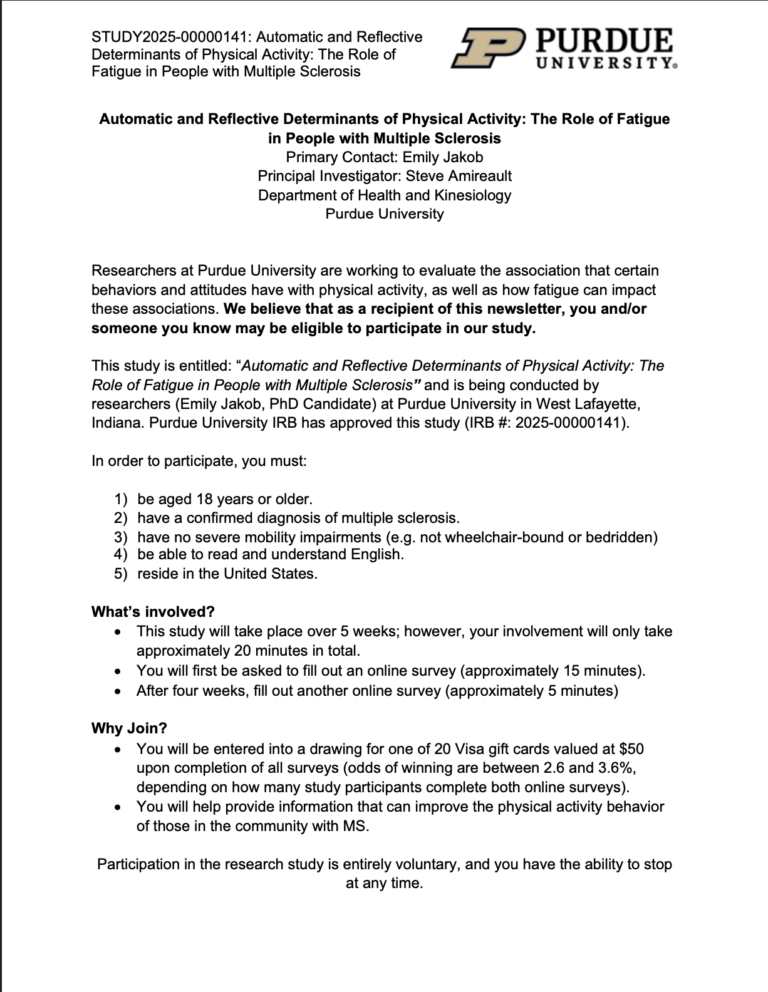
Help Advance Understanding of Physical Activity and Fatigue in MS

Staying physically active is important for managing MS symptoms, but fatigue can make it challenging to maintain an active lifestyle.

Researchers at Purdue University are working to evaluate the association that certain behaviors and attitudes have with physical activity, as well as how fatigue can impact these associations. This study seeks to better understand how fatigue affects physical activity habits in people with MS.

The study is looking for adults with MS. Participation lasts only 20 minutes total over 5 weeks including two online surveys. All participation is completed remotely at your convenience.

Learn more about the study and see if you’re eligible.

flyer of fatigue and physical activity study
Click the flyer above to enlarge.

Do MS Symptoms Change Between Doses? What iConquerMS Members Reported

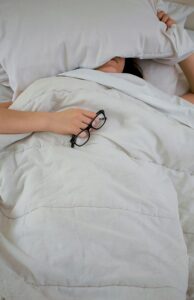
A woman lying in bed under a white bedspread with a pillow pulled over her headSome people living with MS who take anti-CD20 therapies, such as Ocrevus (ocrelizumab) or Kesimpta (ofatumumab), report that certain symptoms seem to worsen before their next dose — an experience often described as a “wearing-off” effect.

To better understand this experience, iConquerMS members partnered with researchers to study symptom patterns between treatment cycles.

In this study, members taking Ocrevus (every six months) or Kesimpta (monthly) completed surveys before and after two consecutive treatment cycles to track changes in fatigue, mobility, cognition, mood, and overall symptom experience.

Worsening of certain symptoms between doses was reported in both groups. However, a higher percentage of Ocrevus participants reported increases in symptoms compared to those taking Kesimpta (50% vs. 27%). Fatigue, mobility, and cognitive changes were reported more frequently among Ocrevus participants.

Because Ocrevus is dosed less frequently, the findings suggest that longer dosing intervals may be associated with a greater likelihood of symptom worsening between doses. The study was designed to compare patient-reported symptom patterns — not to prove a wearing-off effect or to suggest changes in treatment. Therapy decisions remain highly individualized.

Woman lying down in bed under a white comforter and white pillow pulled over her face, holding a pair of glasses..
While clinical trials focus primarily on safety and efficacy endpoints, they do not always capture how symptoms fluctuate between doses in real-world settings. Studies like this one demonstrate how people affected by MS can contribute insights that deepen understanding of treatment experiences over time.

By completing surveys online — on their own time, from wherever they were — iConquerMS members generated findings presented at the 2025 annual meeting of the Consortium of Multiple Sclerosis Centers. This is how lived experience strengthens science.

Read more about the study here and share it with others who might benefit from these insights.

Gaining Familiarity with the Floor

An essay by Elizabeth Keithley
Member of ACP’s Scientific Steering Committee and an iConquerMS member

Babies are placed on the floor. As they learn to walk, they tumble back down and look surprised, then get up and try again. Children play on the floor, getting up and down with ease. Teenagers can also switch easily between the floor and a chair. But as we grow, muscles get tighter and joints less flexible and the floor gets evermore inaccessible. By age 40 or 50 the thought of sitting on the floor just sounds uncomfortable and by 60, 70 and beyond the floor becomes a fearful place, not one to touch except with your feet.

I, of course, developed like everyone else through these stages, but because of spinal cord degeneration, now have very poor balance and therefore an intimate relationship with the floor.

Balance or equilibrium is made possible by neurons in the brain that receive and integrate precisely timed, rapid information from muscles and joints about their state of contraction and position, from the eyes about the horizon and surroundings, and from the inner ear about head position, acceleration and rotation relative to the floor. These neurons continuously monitor our bodies relative to gravity and make rapid responses to our muscles to assure that we do not fall over.

This rapid system is what enables all animals to navigate the earth and its gravitational field. Snakes will right themselves as they are held. Human athletes all have excellent balance. Athletes like skiers, ice skaters, and gymnasts demonstrate obvious balance prowess, but all team sports rely on good balance. Moving quickly and with agility requires good balance. We constantly rely on our balance even though we are unaware of it.

I ice skated, or free-skated, from about age 10 to 35. It is a wonderful sport that lets your heart sing. You can go fast, jump into the air and spin faster and faster as you pull your extended arms close into your chest. You can skate to music or you can make intricate patterns on clean ice called figures that require extreme control over your whole body to assure only one line, made by one edge of the blade, not 2 parallel lines as happens when both edges of the blade touch the ice, is made as you scribe a figure 8 with turns onto the ice. Making figures is a mental meditation. Repetitive to achieve perfection.

I also love to ride a bicycle and do yoga. A bicycle lets you commute in the city without being upset by traffic jams, and for pleasure lets you ride downhill fast leaning into tight turns as you fly. You also must work hard to get uphill, which, when done, is satisfying. Yoga, on the other hand, is a mental sport, like figures in ice skating. Some muscles are stretched while others are contracted thereby creating strength and flexibility in your body. The only sport left for me now is yoga. Speed is no longer accessible.

Multiple Sclerosis is a degenerative disease of the nervous system. The fiber tracts that connect neurons to each other lose segments of their myelin sheath resulting in slowed and uneven conduction velocity. The final consequence is that the brain’s neurons that receive and combine or integrate all the sensory input required to make good decisions about the body relative to the floor make poor decisions. To compound the difficulty, the fibers that carry the decisions to the muscles also travel discordantly.

So, when imbalance occurs, it is very difficult to stop the fall. Gravity prevails.

How to survive with a dysfunctional equilibrium? Relax, let go and mind the furniture. Although I don’t consider myself lucky for having this disability, I do consider myself lucky for having been an ice skater. Why? Because skaters fall all the time! I learned to fall as a kid and learned how to get up quick as a wink. No one tells or teaches skaters how to fall, but if you don’t spontaneously figure it out, you probably quit skating. The key is to relax and don’t fight it.

On the floor again….

Editor’s note: This section belongs to you. If you have a story, poem, artwork, or photograph you’d like to share, we’d love to hear from you — contact Cristal Balis, director of marketing and communications, at cbalis@acceleratedcure.org.
The Next Discovery Starts Here

Every finding we share depends on a community that shows up. Help us keep growing.

Stay up-to-date on the latest from Accelerated Cure Project and iConquerMS!