
Introducing the ACP Data Challenge Pilot
This fall, Accelerated Cure Project for MS is opening up its research ecosystem, one of the most comprehensive in MS, and inviting researchers to interrogate its data to see what answers it might hold.
The ACP Data Challenge Pilot will give researchers access to ACP’s research environment on DNAnexus, a cloud platform for managing and analyzing large-scale genomic and clinical data. Teams will work with decades of multi-omic data (biological information spanning genes, proteins, and immune markers) drawn from more than 6,000 people living with MS, as well as a decade-long longitudinal study conducted through iConquerMS—ACP’s people-powered research network.
The challenge is open to researchers and multidisciplinary teams including computational biologists, MS neurologists, data scientists, early-career investigators, trainees, and people living with MS who want to engage directly in the science. Accepted teams receive a $5,000 stipend, mentorship, and subject-matter expert access throughout the project period.
The bet is that putting fresh eyes and new analytical approaches on this scale of data will surface hypotheses and collaborations that wouldn’t otherwise emerge. And this is meant to be the first of many: each future challenge will add more data, more participants, and sharper questions.
Applications are open now, and the deadline for submissions is July 6, 2026. Submit your research idea and become part of this inaugural event. Sponsorship opportunities are also available. Contact ACP Chief Scientific Officer Stephanie Buxhoeveden at sbuxhoeveden@acceleratedcure.
ACP partners with the National Multiple Sclerosis Society on Voice of the Patient Report
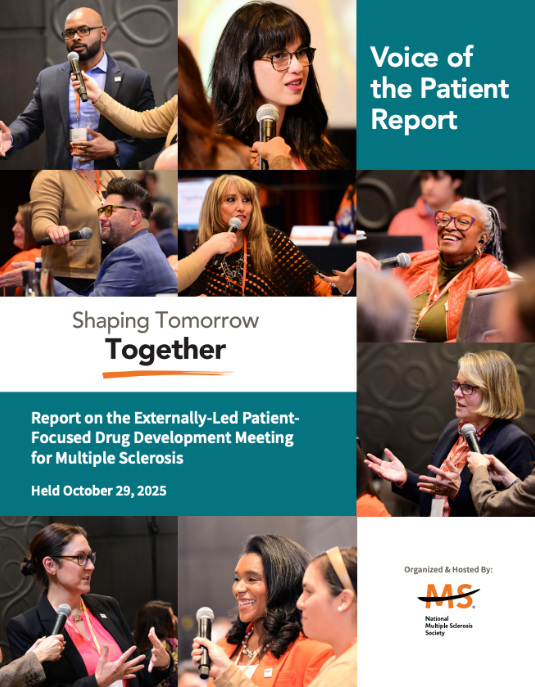
The National Multiple Sclerosis Society has released its Voice of the Patient Report, and ACP is proud to have been a partner in bringing it to life. Developed in parallel with the FDA’s patient-focused drug development program through the Shaping Tomorrow Together initiative, it’s one of the most comprehensive documents ever produced on the lived experience of MS.
The report synthesizes insights from a public meeting and a companion survey completed by 2,892 people living with MS and care partners, documenting lived experiences, treatment trade-offs, and unmet needs across MS types and disease stages. Our team led the effort to develop, test, and analyze the survey.
A few findings stand out for researchers. Sixty-five percent of respondents reported stopping at least one DMT, most commonly due to worsening MS, intolerable side effects, or a physician recommendation. And 42% experienced worsening of existing symptoms in the past year unrelated to any relapse—a reminder that “stable” on paper doesn’t always reflect the lived experience of MS.
The full report, including an executive summary and complete survey data, is available at nationalmssociety.org/
A decade of inclusive research leadership, marked by a new dissemination resource
The MS Minority Research Engagement Partnership Network (MREPN) was created by ACP in 2016 with PCORI funding and a straightforward premise: MS research would produce better science that benefits more people if underrepresented communities were meaningfully included in it. Ten years later, that premise has become a field-wide expectation, and MREPN has been part of building it.
The network is a multi-stakeholder collaborative that includes people living with MS, clinicians, researchers, advocacy organizations, and industry partners. It’s the only collaborative of its kind in MS research. MREPN has surveyed nearly 2,600 people from different backgrounds about their research participation attitudes and experiences. We’ve published toolkits for research professionals and clinicians, built a searchable repository of minority health and research resources, and convene regularly to share information and identify opportunities for collaboration.
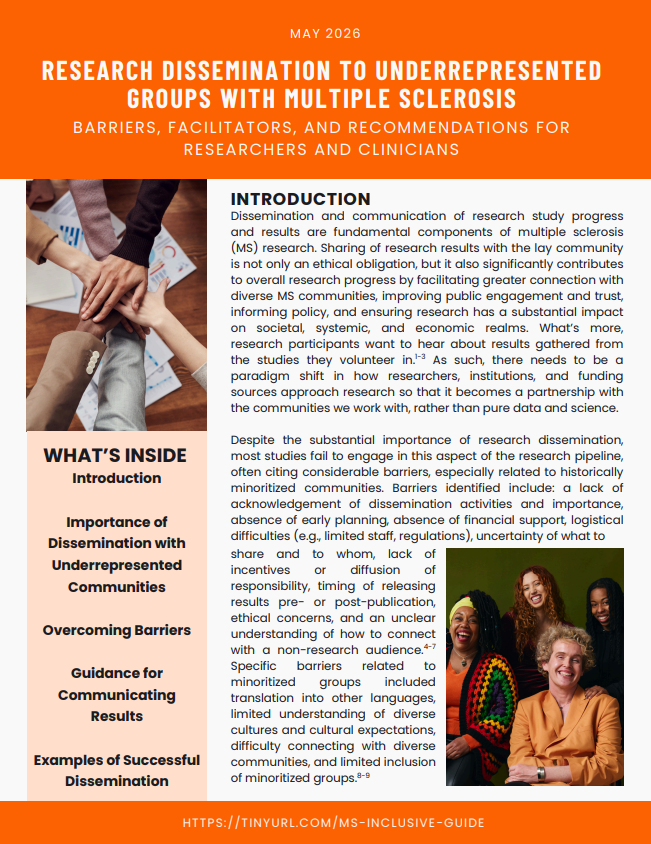
As MREPN marks its 10th year, the network has released a new guidance document: Research Dissemination to Underrepresented Groups with Multiple Sclerosis: Barriers, Facilitators, and Recommendations for Researchers and Clinicians.
It’s a practical resource for researchers who want their findings to reach beyond the journal, and to build the kind of trust with underrepresented communities that makes future research possible. If you’re designing a study, it offers tools for building a dissemination plan from the start before budgets and timelines are fixed. If you’re wrapping up a study, it identifies low-to-no-cost options for sharing results with participants and communities. And if you’re working with or hoping to reach underrepresented communities, it provides guidance on communication formats, cultural considerations, and partner organizations that can help extend your reach.
Download the full document below. ACP also maintains a catalog of publications and other inclusive research resources at acceleratedcure.org/resources-
MREPN membership is free and open to all. To join, contact msminorityresearch@
ACP at CMSC 2026
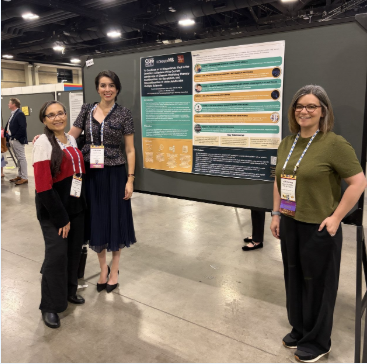
Pictured from l to r: iConquerMS member Nora Gutierrez, Cristina A. F. Román, and ACP Chief Scientific Officer Stephanie Buxhoeveden.
ACP presented two posters at the Consortium of Multiple Sclerosis Centers (CMSC) 2026 annual meeting, both made possible by the iConquerMS research network.
To continue or to discontinue: DMT decisions in older adults
More than half of people living with MS are now over age 55, yet older adults have been largely excluded from disease-modifying therapy (DMT) research. That leaves clinicians and patients to navigate continuation, de-escalation, and discontinuation decisions with little empirical guidance.
To address that gap, ACP Chief Scientific Officer Stephanie Buxhoeveden, PhD, MSN, FNP-BC, MSCN, and Cristina A.F. Román, PhD, along with the iConquerMS PCORI Convening Award Project Steering Committee, conducted a multi-stakeholder landscape review of the available evidence, drawing on 26 empirical studies, real-world evidence, and expert opinion.
Seven themes emerged from the review. Relapse risk is low in stable older adults, and most post-discontinuation changes show up only on MRI rather than in clinical outcomes. Perhaps most importantly, this isn’t a binary choice: the literature supports a spectrum of options, and people living with MS emphasized wanting the flexibility to revisit decisions over time. See the full poster for all seven themes.
The takeaway is a shift toward individualized, risk-stratified decision-making, with structured monitoring, attention to comorbidity burden, and shared decision-making built in from the start.
This work was funded by the Eugene Washington PCORI Engagement Award Program. View the full poster here: [link]. If you’re working on related research and think there’s an opportunity to partner with ACP, contact Stephanie Buxhoeveden at sbuxhoeveden@acceleratedcure.
Humoral and cellular immune responses to COVID-19 vaccination across DMT classes in a decentralized MS cohort
Prior research on how DMTs affect COVID-19 vaccine response has focused largely on antibody levels. This COVER-MS substudy looked at both humoral (Spike IgG) and cellular immune responses across DMT classes, in a cohort of 236 participants. The study was conducted through iConquerMS, which provided the infrastructure for remote consent, surveys, and participant communication.
The findings show that DMTs don’t uniformly suppress immunity; each class produces a distinct profile. B-cell-depleting therapies sharply reduced antibody responses but preserved or increased cellular responses, suggesting humoral and cellular immunity can move independently. S1PR modulators showed broad suppression across both. Fumarates reduced cellular responses across multiple models. mRNA-1273 outperformed BNT162b2 in early antibody response.
This study was funded by the National Multiple Sclerosis Society and Quest Diagnostics, which also provided in-kind sample collection, processing, and analysis services. For more information, contact Stephanie Buxhoeveden at sbuxhoeveden@acceleratedcure.
COVER-MS takes decentralized research to scale

The COVER-MS immune response substudy (see previous story) ran entirely without participants traveling to a specialty MS center. Kits were mailed directly to participants’ homes; blood draws happened through local Quest Diagnostics locations or mobile phlebotomy services that came to participants; surveys and consent were completed electronically.
The result: 236 participants across 41 states and the District of Columbia, with 83% completing all three visits over roughly a year and a half, a retention rate that compares favorably to many site-based studies.
This study was made possible by iConquerMS’s ability to recruit participants, collect data, and facilitate decentralized sample collection at scale. To learn more about how we approached this, see our 2025 CMSC poster on the COVER-MS biological sample collection process.
For researchers thinking about how to reach geographically dispersed populations, reduce the burden on participants with mobility limitations, or expand a study’s reach beyond major academic centers, this design offers a working template. ACP and iConquerMS have direct experience standing up this kind of infrastructure and are glad to discuss how it might apply to other studies. Contact Stephanie Buxhoeveden at sbuxhoeveden@acceleratedcure.
ACP at BIO 2026
ACP will be at BIO 2026 in San Diego, June 23-26, and welcomes the chance to connect with researchers and organizations exploring how ACP’s resources might support their work.
If you’re attending, don’t miss ACP’s own Hollie Schmidt, vice president of scientific operations, who will be featured on the panel “Accelerating Discovery While Protecting Patient Data: Federated Learning at Scale,” Wednesday, June 24, 11:00 a.m.-12:00 p.m., Room 30DE.
To set up a meeting, find us through the BIO Partnering System or contact Stephanie Buxhoeveden at sbuxhoeveden@acceleratedcure.
DOD funding: apply now

The Congressionally Directed Medical Research Programs (CDMRP) has announced anticipated funding opportunities for the FY2026 Multiple Sclerosis Research Program (MSRP). Award mechanisms range from early investigator grants to larger clinical trial awards, with funding up to $2M across focus areas including CNS repair, disease progression, symptoms and their treatment and management, and MS etiology. The deadline for letters of intent is July 30, 2026, and full proposals are due August 13, 2026. Learn more here.
If your study could benefit from access to an engaged participant network, biosamples and longitudinal data from people living with MS, or support for inclusive research engagement, let’s talk about how we might partner on a successful application. Contact Stephanie Buxhoeveden at sbuxhoeveden@acceleratedcure.