PERSPECTIVES
What happens at MS conferences?
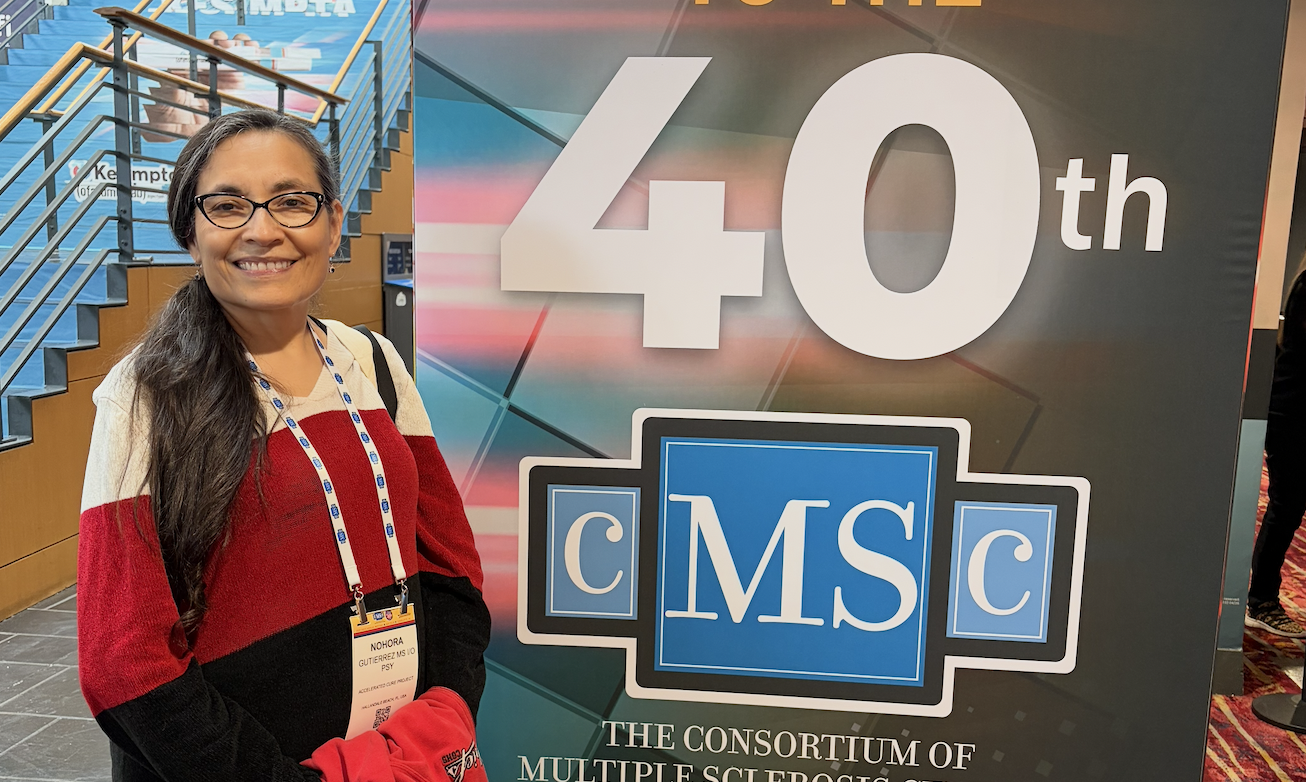
For iConquerMS and RIDE Council member Nora Gutierrez, attending the Consortium of Multiple Sclerosis Centers (CMSC) annual conference in Charlotte, N.C. this year was an experience—and an eye-opening one. CMSC brings together thousands of MS clinicians, researchers, and organizations to share the latest science and advances in MS care, and Nora was “in the room” to take it all in.
“Every meeting room I entered, I felt at home. The discussions and presentations were specific to MS. I did not have to explain my illness or symptoms; the professionals understood my MS journey.”
– Nora Gutierrez, iConquerMS member
In the video above, Nora takes us behind the scenes, sharing what really happens at these conferences and what surprised her most. Afterward, we sat down with her to go deeper about her experience. Read the full Q&A on our website.
ACCELERATING BREAKTHROUGHS
Unleashing two decades of MS data: introducing the ACP Data Challenge Pilot

ACP has spent more than two decades building one of the most comprehensive MS research ecosystems in the world: biosamples, multi-omic data, and longitudinal health information from thousands of people living with MS. This fall, we’re unleashing it in a way we never have before.
Data challenges have proven to be powerful engines of discovery in other disease areas—accelerating breakthroughs by inviting fresh eyes, the latest technology, and new analytical approaches to complex datasets. The ACP Data Challenge Pilot brings that model to ACP for the first time, giving three multidisciplinary research teams broad access to our research ecosystem to pursue original questions this data is uniquely positioned to answer.
This Challenge is only possible because of the thousands of people who have generously contributed their biosamples and health data over the years.
We’ll be sharing updates as the Challenge gets underway later this year. In the meantime, help support this first-of-its-kind initiative—make a donation today.
COMMUNITY IMPACT
ACP helped shape one of the most comprehensive reports ever produced on living with MS
The National Multiple Sclerosis Society recently released the Voice of the Patient Report, and ACP is proud to have been a partner in bringing it to life. Developed through the Shaping Tomorrow Together initiative in parallel with the FDA’s patient-focused drug development program, it’s one of the most comprehensive documents ever produced on the lived experience of MS. Our team led the development, testing, and analysis of the companion survey completed by nearly 3,000 people living with MS and care partners.
The findings are striking. Sixty-five percent of respondents reported stopping at least one disease-modifying therapy, most commonly due to worsening MS or intolerable side effects. And 42% experienced worsening symptoms in the past year unrelated to any relapse—a reminder that “stable” on paper doesn’t always reflect what life with MS actually feels like.
Ten years of making MS research work for everyone

Most MS clinical trials have been conducted on a narrow slice of the people living with the disease. That’s not just a fairness problem. It’s a science problem.
Ten years ago, ACP founded the MS Minority Research Engagement Partnership Network (MREPN) to do something about it. The only collaborative of its kind in MS research, MREPN brings together people living with MS, healthcare providers, researchers, advocacy organizations, and biopharmaceutical companies united around a simple idea: MS research produces better science when it includes everyone. That idea has become a field-wide expectation, and MREPN has played a critical role in making it one.
A decade of work has produced real results. MREPN has surveyed nearly 2,600 people with MS across racial and ethnic groups, published toolkits for researchers and clinicians, and built a searchable library of minority health and research resources.
To mark its 10th year, the network has released a new guidance document to help researchers share their findings with underrepresented communities — offering practical tools for building a dissemination plan, low-to-no-cost options for sharing results with participants, and guidance on communication formats and partner organizations that can help extend their reach.
The network continues to grow, and its members remain committed to ensuring MS research reflects the full diversity of the community it serves. Explore MREPN’s resources at acceleratedcure.org/ms-mrepn.