


Introducing PRADA: research priorities set by people affected by MS   Learn More →

PRADA landing page

iConquerMS logo

THE PRADA PROJECT

A people-powered research agenda for MS

A group of diverse men and women sitting in. a circle having a conversation

The Prioritized Research Agenda Development and Advancement (PRADA) project is a community-led research priority-setting process that identifies and prioritizes the MS research questions that matter most to the MS community.

Built through iConquerMS—a global, people-powered research network of individuals affected by MS—this work brings the perspectives of people directly affected by MS into research priority-setting through a structured, collaborative process.

The Top 10 MS symptoms research priorities

Click on each question below to expand the section for deeper context and analysis.

Why this question matters: Having this information could help people with MS better understand the underlying cause of the symptoms they are experiencing, or predict which symptoms they may experience in the future. It could also provide the potential for location-specific treatments, such as transcranial direct current stimulation, a non-invasive treatment involving mild electrical currents.

Background:MS symptoms can sometimes be linked to specific lesion locations based on the functions carried out at that location. For example, optic nerve lesions can cause problems with vision. Not all symptoms and lesion locations can be easily mapped, however. Factors that complicate this mapping include symptoms involving functions that are distributed throughout the central nervous system, lesions affecting a circuit that routes messages through the nervous system, lesions in locations that don’t result in definitive symptoms, and lesions located in the gray matter which are harder to detect on MRI images. New research techniques are being applied to imaging and clinical databases to map relationships between lesion locations and more complex symptoms. Continued research in this area and translation to individual cases could provide the answers that people with MS are looking for.

Why this question matters: Fatigue is a very common symptom in MS, and is often a debilitating one. Understanding what affects the severity of fatigue, as well as why some people with MS don’t experience it, could point to treatments and strategies for reducing fatigue, including personalized approaches.

Background: Fatigue is known to be made worse by MS-related factors such as depression, medications, and MS symptoms that cause sleep disturbances. The severity of fatigue has also been correlated with higher disability and lower cognitive (thinking) processing speed. Several mechanisms related to nerve degeneration and/or inflammation underlying MS fatigue and affecting its severity have been proposed. These mechanisms include impacts on how well axons (long-distance nerve segments) transmit signals, the production of neurotransmitters (chemical messengers) within the brain, and energy supply. However, the specific causes have not been fully determined.

Why this question matters: The answer to this question would help people with MS know what to expect as they get older, and also help inform the question of whether or not to discontinue DMTs later in life.

Background:
The immune system changes with aging (a process that is called immunosenescence), which includes a shift to a more inflammatory state. Therefore it might be expected that symptoms would become worse in older years. Changes associated with normal aging would also be expected to contribute to worsening of certain symptoms. Some studies have published changes in disability rates over time using general disability scales, but data on the course of individual symptoms is lacking.

Why this question matters: Understanding the factors affecting temperature sensitivity could lead to strategies, methods, or therapies for helping people with MS to function well in different conditions and climates.

Background:

Higher internal (core) body temperatures have been found to slow or block signal conduction in demyelinated axons. However, the exact mechanism underlying this impaired transmission is unknown. One proposed explanation is that new sodium channels (structures in the walls of axons that help with signal transmission) created to compensate for the lack of myelin are more sensitive to temperature. There are also open questions about whether heat sensitivity is dependent on increases in core temperature, or whether skin exposure to sunlight or other sources of heat that don’t increase core temperature can also impair function. Anxiety about ambient temperatures may also compound this effect.

Cold sensitivity has been associated with the presence of lesions in the hypothalamus (part of the gray matter in the brain) which interfere with autonomic (involuntary) responses and can lead to hypothermia. There is some evidence that lowering the core temperature may also interfere with neural conduction, although again the mechanisms are not understood.

Why this question matters: Low levels of serum vitamin D have been associated with a higher risk of developing MS, with anti-inflammatory effects being proposed as the basis for its protective effect against autoimmunity. The Coimbra protocol of high-level vitamin D supplementation (~40,000 IU/day) was developed to treat vitamin D resistance, a syndrome which has been hypothesized to be present in a subset of people with MS or other chronic diseases.

Background: A systematic review of vitamin D supplementation trials found inconclusive evidence for effects on outcomes such as symptoms (e.g., fatigue or depression), relapse rates or disability. However, none of the trials used daily doses of vitamin D approaching the levels specified in the Coimbra protocol.

Why this question matters:

Diet has been shown to affect the risk and severity of many health conditions. For example, the autoimmune response in celiac disease is triggered by eating gluten. It has been hypothesized that certain ingredients in the diet of people with MS could similarly trigger or enhance an inflammatory response in the central nervous system that leads to worsening of symptoms. This effect could be the result of various mechanisms, including changes in the bacteria residing in the digestive system (microbiome), production of antioxidants, and communications between the brain and digestive system (gut-brain axis).

Background: Several types of diets have been studied for their effect on MS, including variations of a paleo diet (such as the Wahls diet), ketogenic diets, and low-fat diets (such as the Swank diet). Individual supplements such as vitamin D and fish oil (omega-3 fatty acids) have also been investigated. While some studies have reported positive effects on MS symptoms such as fatigue and depression, conclusive support for any specific diet or supplement is lacking. Moreover, the specific mechanism(s) linking specific dietary strategies to outcomes are unknown.

Why this question matters: Cognitive fatigue is a common and often disabling symptom in MS. Understanding how cognitive burden and fatigue can worsen other MS symptoms could lead to the development of strategies or therapies that support cognitive functioning without worsening in other areas.

Background: Several studies have documented that cognitive burden can interfere with other functions in MS using dual-tasking experiments (e.g., performing cognitive tests while walking on a treadmill). However, research on the effect of cognitive burden on other MS symptoms is lacking. Imaging studies are beginning to uncover associations between cognitive fatigue and damage to certain brain structures and connections. More work is needed to understand the drivers of cognitive fatigue and impacts on other functions and symptoms.

Why this question matters: Dizziness, lightheadedness and vertigo are complex symptoms that may have their origin in MS lesions, disturbances in the vestibular system (a sensory system in the inner ear), or even psychological symptoms such as anxiety. Balance disorders are common in MS and can increase the risk of falls and have a significant impact on quality of life.

Background: A number of approaches have been explored for treating dizziness and vertigo in MS, including head-turning maneuvers to reposition stones in the inner ear, vestibular physical therapy, therapies such as noisy galvanic vestibular stimulation, and mental health medications and therapies. Observational and comparative effectiveness trials have been conducted to assess the efficacy of some of these treatments, but additional research is needed to determine the best approach on an individualized basis.

Why this question matters: Mental health concerns including depression and anxiety are common in people with MS and can significantly affect quality of life, disease management, and overall health outcomes. Understanding the extent to which mental health therapy is being recommended can reveal important gaps in care delivery and help ensure comprehensive treatment that addresses both physical and psychological needs.

Background: Studies conducted to date highlight significant gaps between the mental health needs of people with multiple sclerosis (PwMS) and the support they receive. Surveys and interviews of healthcare providers indicate varying levels of depression screening as a routine practice. Frequency of mental health recommendations and referrals may also vary based on country/region.

Why this question matters: Understanding ethnic variations in the presentation of MS symptoms can improve diagnosis accuracy and tailor treatment plans. Certain ethnic groups may experience earlier disability progression, greater motor or visual symptoms, or differences in lesion location. Identifying differences allows clinicians to offer culturally informed, equitable care and better counseling on what to expect.

Background: Recent research reveals that differences in MS risk and severity do exist among racial and ethnic groups; however, less is known about the differences in the frequencies of specific symptoms across groups. Prior studies have reported higher symptom burden for specific groups; for example a higher rate of optic neuritis in Hispanic/Latinx people, particularly those with Native ancestry, and greater mobility impairment in Black/African Americans.

Blue and green intersecting lines

Learn more about PRADA

Overview

Through our first PRADA project, iConquerMS members collectively identified the top 10 MS research questions that matter most to people living with MS—focusing on symptoms and their treatment and management. The process was truly collaborative: members proposed questions, discussed them, and voted on priorities through multiple rounds. The iConquerMS RIDE Council played a vital role throughout, ensuring voices from communities who have historically been left out of the research process helped shape the final list.

PRADA ensures that people living with MS have a direct role in setting research priorities directly, complementing the priorities researchers and funders have already identified. This is what people-powered research looks like—when the community not only participates in research but directly sets the agenda for where research efforts should focus next.

Why This Matters

MS research is strongest when scientific expertise and lived experience inform one another. PRADA bridges that gap by offering researchers and funders a community-defined set of priorities that can inform study design, funding decisions, and future lines of inquiry.

By grounding research priorities in the perspectives of those most affected, PRADA supports research that is more relevant, inclusive, and responsive to real-world needs. The resulting agenda is intended to align research efforts with the questions people in the MS community are most eager to see answered.

The PRADA process

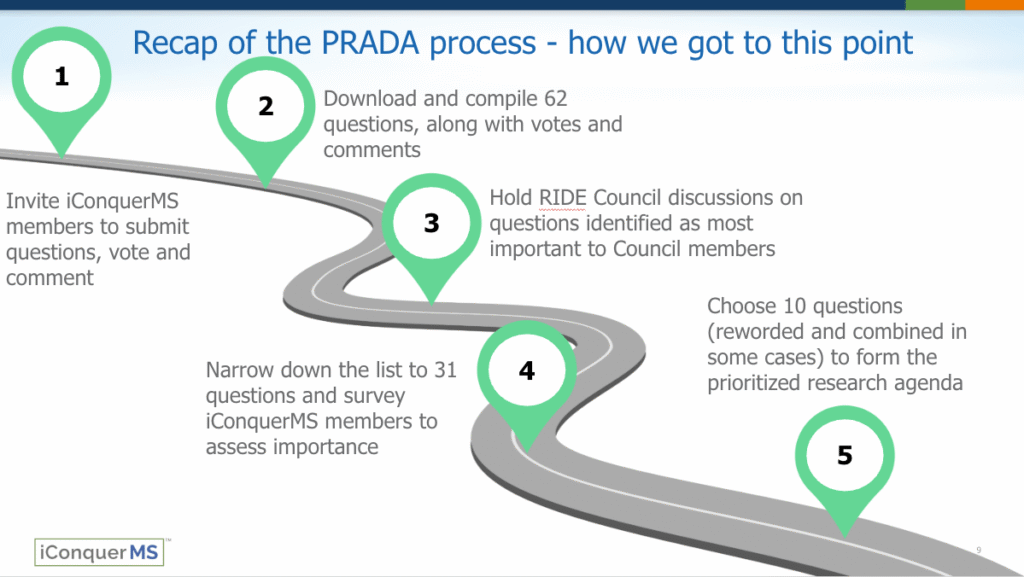
Visual of winding road, showing the steps of the PRADA process along the way

PROJECT FOUNDATIONS
PRADA was coordinated by a small leadership team that included ACP staff, a member of the iConquerMS RIDE Council, and an independent professional facilitator. This team supported the process administratively and logistically, while research priorities and decisions were driven by community input. 

A multi-stakeholder steering committee was convened in October 2024 to guide the project. The committee included iConquerMS community members, RIDE Council representatives, researchers, clinicians, and a representative from the National MS Society. Early meetings focused on shared goals, timelines, and guardrails to keep the process community-centered. 


GATHERING COMMUNITY PRIORITIES
PRADA is built on the Our Questions Have Power program, which invites iConquerMS members to submit topics related to MS symptoms and treatments they want the research community to address. Prior to PRADA’s launch, approximately 40 questions related to MS symptoms and their treatment and management had already been submitted.

With the launch of PRADA, iConquerMS members were invited to propose additional questions and to vote and comment on existing ones. In total, 62 research questions were submitted by community members. These questions and associated engagement data formed the foundation for the prioritization process.


CENTERING UNDERREPRESENTED VOICES
Members of the iConquerMS RIDE Council reviewed the full set of submitted questions and independently selected their top priorities. To avoid bias, Council members were not shown overall community voting results.

RIDE Council sub-councils—including Black/African American, Hispanic/Latinx, and Emerging Voices groups—met separately in facilitated discussions to explore which questions mattered most and why. 

These conversations focused on unmet needs, community concerns, and the real-world impact of MS, and the insights were documented and incorporated into later decision-making.


REFINEMENT AND BROADER VALIDATION
After incorporating RIDE Council input, the Steering Committee reconvened to review both community engagement data and qualitative feedback. From the original 62 questions, the committee identified 31 priority questions that reflected shared importance across both the broader iConquerMS community and RIDE Council members. Minor wording changes were made to improve clarity and inclusivity.

These 31 questions were then redistributed to the broader iConquerMS community through an online survey. More than 600 members rated the importance of each question on a 1-5 scale and provided demographic information to help interpret the results and surface priorities across different communities.


FINALIZING THE PRADA AGENDA
The Steering Committee met again to review survey results, paying close attention to how questions were rated across demographic groups. Special consideration was given to feedback from historically underrepresented communities to ensure the final agenda reflected diverse perspectives.

Based on this review, ten research questions were selected, with final wording refined once more as needed for clarity and inclusivity. A brief literature scan was conducted to understand existing research related to each topic and identify evidence gaps, and the committee confirmed the final list.


MOVING FORWARD
The PRADA project has produced a people-powered research agenda shaped directly by the community it is intended to serve. These priorities are now being shared with researchers, funders, and partners to help inform study design, funding decisions, and future MS research efforts.

PRADA demonstrates what is possible when people affected by MS are not only consulted—but invited to lead in setting the research agenda.

Special Thanks

We want to thank the members of iConquerMS community who participated in the development of this agenda, and are grateful to Bristol Myers Squibb and EMD Serono for providing the funding that made this project possible.

What comes next

Accelerated Cure Project and iConquerMS will use these community-defined priorities to guide upcoming studies, data collection, and dissemination efforts. Researchers and industry partners interested in conducting research to help answer these questions are invited to connect with ACP to explore opportunities to leverage:

  • ACP’s research-ready infrastructure, including a repository of MS biospecimens, clinical and participant-reported datasets, and access to a vast network of research, pharma, and technology partners
  • Participant recruitment through iConquerMS, enabling rapid identification of people affected by MS based on study-relevant criteria
  • Engagement with underrepresented communities, including both access to underrepresented research participants and consultation with the RIDE Council for guidance on inclusive study design and implementation


Interested in advancing community-defined MS research priorities? Let’s explore how we can work together. For research and industry inquiries, contact us at partner@acceleratedcure.org or click the link below.